
Path To The Customer
Why marketing is more than just advertising
Happy Thursday, 👋
Founders are often great at building. They can see a problem, imagine a better product, assemble a team, and spend months turning an idea into software, a service, or a new way of working.
Solving a problem with a new product or service is only one part of the company-building process. A startup is also judged by whether customers care enough to change behavior, spend money, and keep using what the company has built.
Marketing often gets treated like something that happens after the product is finished. The sequence is familiar: Write code, release the product, update the website, post on social media, then wait for customers to appear. That approach often creates a dangerous gap. A company may spend years building something impressive without developing a clear answer to one of the most important startup questions: how are you getting customers?
As venture investors, that question is central to our diligence. We want to understand whether the company has a credible path from idea to customer demand, from customer demand to revenue, and from revenue to scalable growth.
Marketing Is Not Advertising
The first mistake is assuming marketing means advertising. A logo, social media posts, and corporate swag can be parts of marketing, but they are not the foundation.
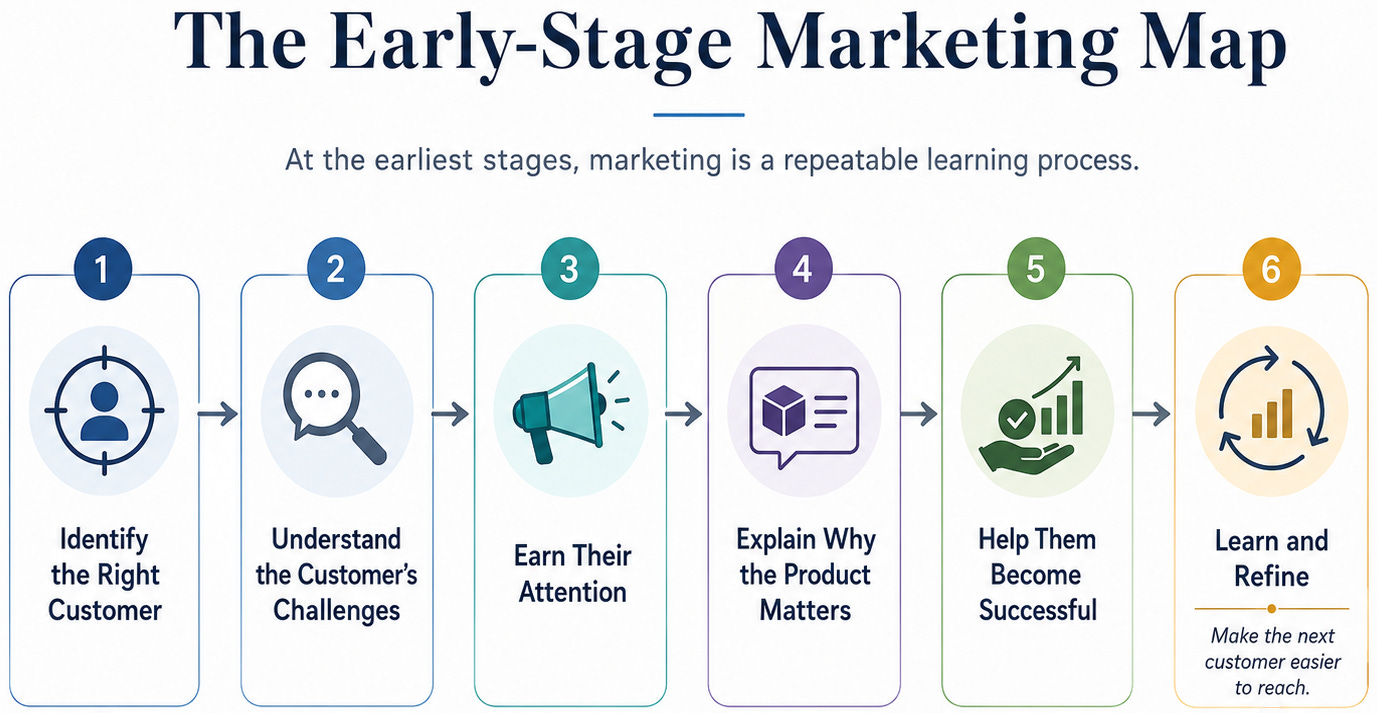
At the earliest stages, marketing is the process of identifying the right customer, understanding the customer’s challenges, earning their attention, explaining why the product matters, helping them become successful, and learning enough from that process to make the next customer easier to reach. Marketing maps the process. Advertising is just one component.
Many startups approach product-market fit backwards. They build a solution and then go looking for a problem that fits what they already built. Sometimes that can work, but it often leads to a product in search of a market.
Better startup teams think about the market and the audience while they are building the product. They ask who feels the problem most intensely and learn how that customer describes the problem in their own words. They identify who has budget, authority, urgency, and the most to lose if nothing changes.
Great Ideas Still Need Distribution
A great idea is the first step. The second step is telling the right people about that idea and convincing them to pay for what the company is building.
A startup team may be excellent at writing code, designing products, or solving technical problems. But venture-backed companies become valuable because the market adopts what they built.
That is why the customer acquisition plan is one of the areas we evaluate during diligence. We want to know whether the team has a plan to move the product from idea to sales. We want to understand what evidence exists that the market needs the product, and whether that evidence is based on real customer behavior or just encouraging conversations.
Metrics can tell the wrong story if they are not tied to customer behavior. A platform may have thousands of accounts, but if most users log in once and never return, that does not show strong market demand. A waitlist may look impressive, but if few people convert into paying customers, the waitlist may reflect curiosity more than urgency. A pilot project may sound promising, but if it never turns into a paid deployment, it may be more of a science project than a sales process.
Markets speak through behavior. CB Insights analyzed 431 VC-backed companies that were not successful. In over 40% of the cases, a lack of product-market-fit was cited as a leading cause of failure. A common pattern is a startup having a strong start and using that momentum to raise early capital, only to later discover that customers did not find enough value in the product or that early interest was never converted into a longer-term revenue stream.
The First Customers
The first customers are often friends, family, former colleagues, or first-degree connections to the founder. They are more likely to take a chance on an unfinished product and more willing to provide feedback.
That first feedback loop can be extremely valuable. The risk is assuming those early customers fully validate the long-term market. A friend who buys because they trust the founder is not the same as an unknown customer who buys because the product solves an urgent problem.
Early customers help a team learn. Later customers help prove whether the learning can scale beyond the founder’s immediate network.
Paul Graham summarized this by stating, “startups take off because the founders make them take off.” Founders should not wait for users to discover them. They must recruit customers, start conversations, ask for introductions, explain the product, and create the first signs of momentum.
The first few weeks or months might feel like nothing is happening, but slowly momentum starts to build. This is one reason teams need a marketing plan. It becomes the roadmap during those first few months when progress feels stalled. The plan keeps the team focused on working the process instead of being distracted by a lack of early traction.
We also encourage teams to pay close attention to customer feedback. Ask what attracted customers to the product, what problem they believe it solves, which words they use to describe the value, and what would make them use it more often.
No marketing plan can fully predict customer behavior, but the best teams listen to feedback and adjust to the market. Flickr emerged from photo-sharing tools originally built inside a multiplayer online game. YouTube started with an early dating concept before becoming a general video-sharing platform. Bubble Wrap was first conceived as textured wallpaper before finding its niche in packaging.
Founders who approach the process with openness to feedback may find the market does not always respond to the original story, but it often leaves clues about a better one.
Sales Without Suits
Marketing an early-stage product is different from selling a known brand. At the earliest stages, nobody knows the product, the company, or even the team. Early customers are buying product features, but they are also buying belief in the team itself. They are deciding whether the founder understands their problem, whether the team can deliver, and whether the product will have a meaningful impact on their business.
This is why founder-led sales matters so much in the early stages. The founder can explain the original insight, connect the product to the customer’s problem, and use feedback to quickly adjust.
If a founder does not enjoy marketing or sales, that is okay. Most would rather build the product than sell it, but they should still be part of the discussion. Hiring a salesperson can be a strong move early in the process and is something we look for in our diligence. It should be someone who can tell the story with conviction, look for important feedback signals, and help the team follow the marketing plan.
Final Thoughts
Marketing might not be the first thing on a founder’s list, but it should be on the list early. A well-defined marketing plan is often the difference between a product that exists and a product the market adopts.
At the early stage, marketing is not about polish. It is about discipline: Talking to customers, understanding pain points, testing messages, and listening closely enough to adjust. Early conversations become early customers. Early customers become evidence. Evidence becomes the foundation for repeatable growth.
Marketing also helps reframe rejection as learning. The first customer who says no may provide the insight that makes the next customer say yes. The first awkward sales conversation may reveal a sharper message, a better buyer, or a stronger use case. Having a plan helps the team stay focused on the long-term objective instead of getting knocked off course by early rejection.
Building an amazing product or developing a new approach to a problem is one of the most exciting parts of working at an early-stage company. But startups are not valued for excitement alone. They are valued because customers adopt, pay, return, and tell others. Marketing is the process of turning founder conviction into market traction. The product may be the engine, but marketing is how the company finds the road.
Wishing everyone a great weekend,
-Eric.