
Getting The Customer Meeting
Cost reduction opens the door, value creation earns the renewal
Happy Thursday, 👋
Cost reduction is often the easiest way for a startup founder to begin a potential customer conversation. It is clean, measurable, and usually tied to a budget line the buyer already understands. If a founder can explain how the product or service reduces spending, saves hours, replaces an expensive manual process, or limits waste, the buyer has a clear reason to keep listening.
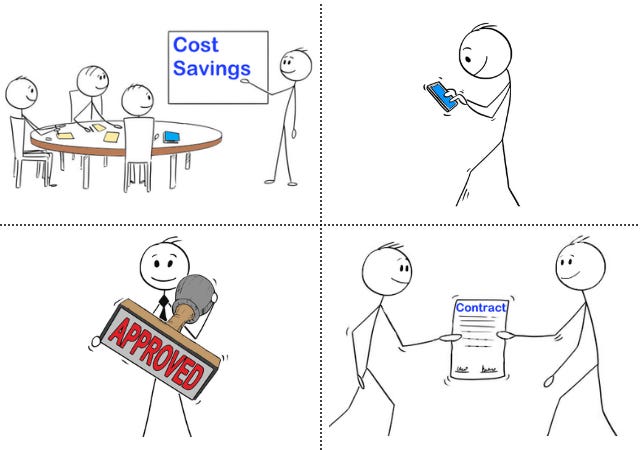
The approval process inside most companies is not designed for abstract improvement. They are built to manage budgets, control risk, and give decision-makers a practical reason to say yes. Cost reduction might get the initial customer meeting, secure a pilot, or even close the first contract. But the first contract is not the same thing as a durable customer relationship. From there, it is up to the founder and the team to turn the initial savings story into long-term value creation.
The Sale a Customer Can Approve
Founders often want to sell a transformative idea. Most startups are launched because someone found a better way to solve a problem, run a workflow, serve a customer, or make a decision. The challenge is that customers do not always buy the better future first. They buy the thing they can get approved internally.
Inside a company, every new purchase has to survive the approval obstacle course: business sponsor, budget review, legal diligence, and management approval. Eventually someone asks the practical question: why are we buying this now?
Cost reduction gives the buyer a crisp internal answer: because it saves the company money. That answer may not capture the full potential of the product, but it gives the buyer something concrete, defensible, and easy to repeat.
Cost Reduction Gets the Meeting
Cost reduction works because the pain is visible and can be quickly quantified. Managing expenses tends to be a focus area during annual planning because it is one of the easier levers for a company to control. A company knows its monthly payroll, software spend, hardware costs, travel budget, and operating expenses. When a startup offers to reduce one of those expenses, the customer can evaluate the proposal in familiar terms. They are being shown a path toward reducing a cost that already exists.
This is why founders should usually include cost savings in the initial customer discussion. It creates a clear business case and lowers the friction required for customers to take the next step. For a startup without years of brand trust behind it, that practical wedge is a material part of closing the sale.
The risk is letting the wedge become the whole story. Products defined only by savings get pulled into the gravity of price. Each renewal can become another discount discussion. Cheaper is useful, but rarely enough to build deep customer loyalty.
Value Creation Is Harder to Sell Early
Value creation is often more powerful, but harder to sell at the beginning. It requires the customer to imagine a better operating state that does not yet fully exist. More efficient employees, higher manufacturing production, better decisions, or more coordinated patient care are valuable outcomes, but they may require new workflows or cooperation across departments.
A value creation pitch can sound strong until it runs into the reality of how most companies operate. The product may not map directly to a single departmental budget. The users may be different from the person approving the contract. The team receiving the value may not be the team responsible for the spend. The value pitch may be right, but the internal path to approval can still be difficult.
There is also a measurement problem. Cost savings can often be shown quickly. Value creation may take longer. A customer may not know how to quantify the day-one value of faster collaboration, lower operational risk, better data quality, or stronger decision-making. These outcomes matter but often do not show up neatly on the first invoice.
The Better Sequence
The stronger approach is to understand how cost reduction and value creation work together. Cost reduction helps a buyer justify the first step. Value creation helps the product become important enough to renew, expand, and defend over time.
A useful sequence we have used is:
Day one: what cost does this reduce?
Year one: what process does this improve?
Long term: what new capability does this create?
The above sequence gives the customer a path. The first step reduces friction. The second builds adoption. The third creates strategic value. The pilot should prove the savings case. The first year should prove the workflow improvement. The renewal should make clear that the product is now part of how the company operates.
Cell phones are a useful consumer example of how this sequence unfolds. Phones are often listed for $1,000 or more, so carriers find ways to offer customers a discount, trade-in, or installment plan. That is the cost reduction story on day one. It reduces the immediate pain of the purchase and helps the customer get comfortable saying yes. Over time, the phone becomes personal infrastructure: messages, maps, email, photos, payments, and daily life. The upfront savings started the relationship. The ongoing value made it durable.
Startups should think about their products the same way. Initial savings can create adoption, but deeper utility creates retention. The goal is to move from being a product the customer purchased to being a product the customer relies on.
Final Thoughts
Cost reduction is often the cleanest way for a startup to enter a customer conversation. It gives the buyer something measurable, defensible, and easy to explain. In a world of cautious budgets and competing priorities, a founder who can clearly explain how a product reduces spending, saves time, or eliminates waste has a better chance of earning the next meeting.
But cost reduction is rarely the full story. Durable startup relationships are built when the product helps the customer operate better. Savings can justify a purchase, but value creation makes the product harder to cancel, easier to expand, and more important to the customer’s daily operations.
The strongest startups understand both sides of this equation. They know how to sell the practical reason to start, then deliver the deeper reason to stay. Cost reduction can get the meeting and help win the first contract; value creation is what earns the renewal.
Wishing everyone a great weekend,
-Eric.