
Corporate Muscle Memory
Big company skills, small company problems
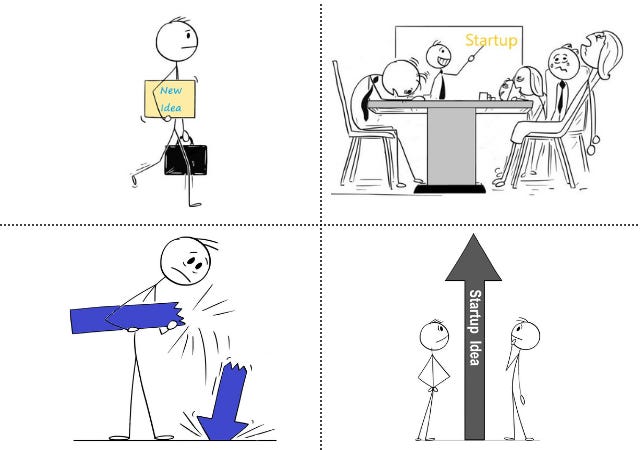
Happy Thursday, 👋
Many founders step out of large companies to launch something of their own. On paper, it makes perfect sense. Years inside a big organization provide exposure to systems, processes, coordination, and scale. You learn how teams work across functions, how customers are supported at volume, and how organizations manage complexity. All of that experience can be incredibly valuable.
But corporate experience comes with a hidden cost.
Most corporate rules are not the result of elegant design. They are the accumulation of years of risk management, coordination, overhead, and well‑intentioned attempts to avoid past mistakes. Over time, those rules harden into habits. Eventually, they become assumptions. This is just how things are done.
The challenge is that founders often carry those assumptions with them.
When someone leaves a large organization to start a company, they do not bring a rulebook. They bring muscle memory. Unwritten norms about meetings, approvals, timelines, and ownership get imported into an environment where they no longer make sense. In a startup, those habits are amplified.
Startups are small, fragile, and time‑constrained. What feels like a minor inefficiency inside a Fortune 500 company can quickly become a meaningful constraint within a small, nimble startup team.
The Meeting Trap
Meetings are usually the most obvious carryover from corporate life. In large organizations, meetings are often the primary signal of engagement and importance. A full calendar suggests value. It implies alignment. Sometimes it even substitutes for progress.
Microsoft found that meeting time per employee increased more than 250% over the past decade. It is hard to argue that productivity rose at anything close to the same rate. In practice, meetings inside large organizations often serve to delay decisions, distribute responsibility, or create cover. A group decision means no single owner and no clear accountability when things go wrong.
Startups do not have that luxury.
Time in a startup is measured against cash in the bank. Decisions need to be made quickly and have a clear owner. If a meeting does not end with a specific next step and a named owner, it was probably an update meeting that could have been an email. Corporations can survive endless update and alignment meetings. Startups need meetings that produce movement.
Warped Time Horizons
Large companies are also very good at stretching timelines. This is rarely intentional. More stakeholders get involved. departments wait on one another. Dependencies stack up. Ownership diffuses. Eventually, nobody feels responsible for the overall schedule.
Founders coming out of that environment sometimes struggle to move fast, even when they intellectually understand the need for speed. The instinct to wait, polish, or fully align can be hard to unlearn.
The advantage of a startup is not that it does everything perfectly. It is that learning and feedback happen quickly. Early products are supposed to be incomplete. Customer feedback is not a failure mode, it is the engine. When founders cling to corporate pacing, they often delay the very feedback that would help them improve.
McMusk‑It
Large organizations tend to treat failure as something to be minimized or hidden. When something breaks, the instinct is often to assign blame, add process, or create another approval step.
Startups need the opposite approach.
SpaceX provides a useful example. The company experienced more than a dozen very public rocket failures, often referred to as Rapid Unscheduled Disassembly. Each RUD or failure was treated as a learning event, not a reputational crisis. Pushing systems to the edge was part of the design, not a deviation from it.
One principle that runs through Elon Musk’s companies is the discipline of questioning every step in a process. If no one can explain why a step exists, remove it and observe the outcome. Interestingly, when large corporations hire consultants to improve operations, one of the first exercises is very similar: map each process and question every step. You do not have to be McKinsey or Musk to adopt this mindset before unnecessary processes take over a growing company.
Another critical idea is ownership. Every requirement, constraint, or process step should be tied to a person, not a department. Without a clear owner, nothing gets questioned and nothing improves. In startups, speed comes from accountability and an active feedback loop.
Final Thoughts
Corporate experience can be a powerful advantage for founders, but only when it is applied deliberately. Startups are not smaller versions of large companies. They are fundamentally different organisms, optimized for learning and speed rather than control and stability.
Meetings should exist to drive decisions and assign responsibility, not to signal activity. Processes should earn their place by creating leverage, not comfort. Timelines should be dictated by learning velocity, not inherited habits.
The best founders actively shed corporate muscle memory. They keep the judgment, pattern recognition, and strategic perspective they earned inside large organizations while discarding the procedures that slow them down.
Large companies reward discussion and alignment. Startups thrive on decisions and momentum.
Wishing everyone a great weekend,
-Eric.